From Idea to Launch: A Step-by-Step Custom Software Development Process That Actually Works
Around 70% of IT projects fail to meet their goals, run over budget, or miss deadlines.
That number is not caused by a few coding mistakes or delayed meetings. In most cases, projects fail because the software development process itself is poorly planned from the start.
Many businesses begin with a strong idea but struggle to turn it into a product that actually works, scales, and supports long-term growth. The gap between having an idea and launching reliable software is often much bigger than companies expect.
This is exactly why understanding the custom software development process matters. A structured approach helps businesses reduce risk, stay aligned with their goals, and build software that solves real operational problems instead of creating new ones.
What Is Custom Software Development?
Custom software development is the process of designing, building, launching, and maintaining software created specifically for a business or organization.
Unlike off-the-shelf tools such as standard CRM platforms or generic business software, custom-built solutions are developed around your specific workflows, goals, and operational needs.
Instead of adjusting your business to fit someone else’s software, custom development allows you to create a solution that fits your business from day one.
This process typically includes:
- Planning business requirements
- Designing the product experience
- Building the software
- Testing functionality and security
- Launching the product
- Improving it over time
The goal is simple: create software that supports growth, improves efficiency, and solves specific challenges.
Why the Software Development Process Matters
Many companies underestimate how important process is during development. They often focus only on the final product and ignore the planning required to get there.
A structured software development process helps businesses:
- Avoid unnecessary costs
- Reduce delays
- Improve communication between teams
- Minimize technical risks
- Build software that can scale with business growth
Without a clear roadmap, even strong ideas can quickly become expensive mistakes.
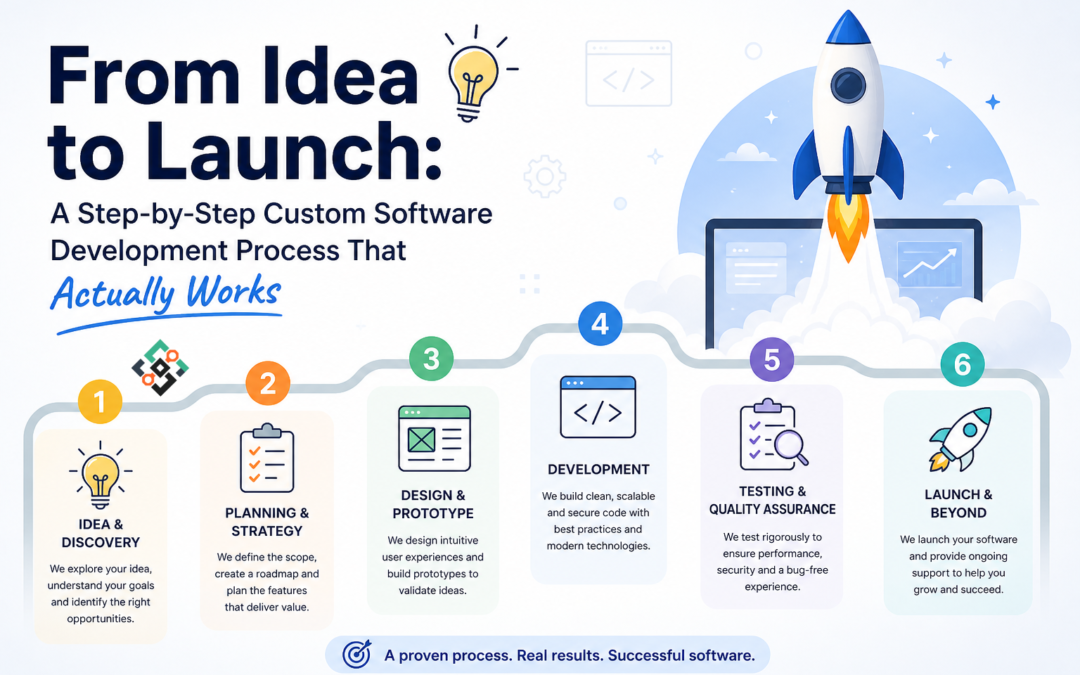
1. Discovery and Requirements Analysis
Every successful software product starts with discovery.
This phase focuses on understanding your business goals, identifying problems that need solving, and defining what the software should accomplish.
During this stage, development teams typically analyze:
- Business objectives
- User needs
- Internal workflows
- Required features
- Integrations with existing systems
- Budget limitations
- Project timelines
This phase helps eliminate confusion before development begins and ensures everyone is aligned on expectations.
Output: Product requirements document, project scope, development roadmap
2. Planning and Software Architecture
Once the requirements are clear, the next step is planning how the software will be built.
This phase focuses on technical decisions that impact performance, scalability, and long-term maintenance.
Teams usually define:
- Frontend technologies
- Backend technologies
- Database structure
- Cloud infrastructure
- Security requirements
- Development milestones
- Sprint timelines
Strong architecture prevents future performance issues and makes scaling much easier as the business grows.
Output: Technical architecture plan and development roadmap
3. UI/UX Design
Before development starts, the product needs a clear design direction.
This phase focuses on creating an experience that is functional, intuitive, and easy for users to navigate.
The design process often includes:
- Wireframes
- User flows
- Interface design
- Mobile responsiveness planning
- Accessibility improvements
- Interactive prototypes
Good design reduces friction for users and improves adoption once the software goes live.
Output: Wireframes, prototypes, design systems
4. Development and Coding
This is where the actual product starts taking shape.
Developers begin transforming designs and technical plans into a working software product.
This phase often includes:
- Frontend development
- Backend development
- API integrations
- Database development
- Third-party integrations
- Agile sprint execution
Most modern teams work in development sprints, allowing businesses to review progress regularly and provide feedback before major issues appear.
Output: Functional software builds
5. Testing and Quality Assurance
Launching software without testing is one of the fastest ways to damage user trust.
Before launch, the product must be tested to ensure it performs properly across different environments.
This stage typically includes:
- Functional testing
- Performance testing
- Security testing
- Cross-browser testing
- Mobile testing
- Bug fixing
The goal is to catch issues before users do.
Output: Stable and tested software product
6. Deployment and Product Launch
Once testing is complete, the software is ready for launch.
This stage includes preparing production environments and ensuring the launch process runs smoothly.
Tasks often include:
- Server configuration
- Data migration
- Deployment automation
- Final performance checks
- Monitoring setup
- Backup and rollback planning
A smooth launch reduces downtime and ensures users can start using the product immediately.
Output: Live software product
7. Maintenance and Continuous Improvement
Many businesses think software development ends after launch. It doesn’t.
Software requires ongoing updates to stay secure, efficient, and competitive.
Post-launch maintenance often includes:
- Bug fixes
- Security updates
- Performance optimization
- Feature upgrades
- Scalability improvements
Technology changes quickly, and businesses evolve even faster. Continuous improvement helps software stay useful over time.
Output: Long-term product growth and stability
Benefits of a Structured Software Development Process
When businesses follow a clear development process, they gain significant long-term advantages.
These include:
- Software built around exact business needs
- Better performance and scalability
- Stronger security protection
- Lower long-term operational costs
- Easier upgrades and future improvements
- Faster adaptation to market changes
A structured process helps businesses avoid reactive decisions and focus on sustainable growth.
Final Thoughts
Custom software development is not just about writing code. It is about building a solution that supports your business goals and creates long-term value.
From discovery and planning to launch and maintenance, every stage plays a critical role in building software that performs reliably and grows alongside your business.
When done properly, custom software becomes more than a tool. It becomes a long-term competitive advantage.