
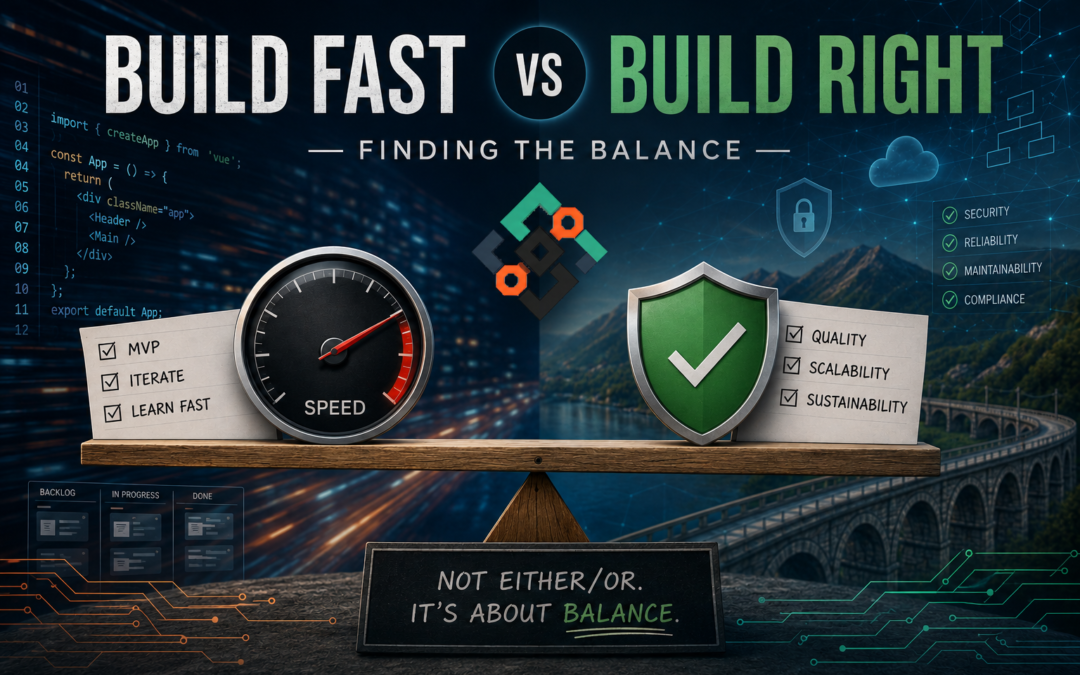
Build Fast vs. Build Right: Why the Smartest Teams Learn to Balance Both
Every product team eventually faces the same uncomfortable question: should we launch quickly and learn on the go, or slow down and build something solid from day one?
At first glance, the answer feels obvious depending on who you ask. Startup founders usually lean toward speed because getting to market first can mean survival. Engineers often lean toward stability because they know how painful rushed systems become later. Product managers sit somewhere in the middle, trying to ship features without creating chaos for the future.
The truth is that neither side is completely wrong.
Some products fail because they took too long to launch and missed the moment entirely. Others collapse under the weight of poor architecture, endless bugs, and technical debt that eventually slows every future release. The challenge is not choosing one side forever. The challenge is understanding when to move fast, when to slow down, and how to build a product that can survive both stages.
Why Building Fast Matters More Than Ever
In today’s market, speed creates opportunity. Products are launched daily, trends shift overnight, and customer expectations evolve faster than most teams can predict. Waiting months to release a “perfect” product often means building features users may never actually need.
That is why many successful companies start with momentum rather than perfection.
Launching early allows teams to validate assumptions in the real world instead of relying entirely on internal opinions. Feedback arrives faster, patterns become clearer, and teams can identify what truly matters before investing heavily into the wrong direction.
For startups especially, speed can become a competitive advantage. Being first to solve a problem, even imperfectly, often creates visibility, attracts early adopters, and opens conversations with investors or partners before competitors arrive.
Fast execution also protects resources. Instead of spending a year building an extensive platform, teams can focus on a lean version that tests the market quickly. If the idea fails, the company learns early. If it succeeds, the product evolves with real user behavior guiding the roadmap.
But moving fast comes with a cost that many teams underestimate.
When speed becomes the only priority, shortcuts quietly pile up in the background. Code becomes harder to maintain, architecture decisions become reactive instead of strategic, and new features take longer to build because the foundation underneath them becomes unstable.
At first, the problems seem manageable. A few bugs here, a workaround there. Then suddenly every update introduces unexpected issues, onboarding new developers becomes painful, and scaling the product feels like renovating a building while people are still living inside it.
This is the hidden price of unchecked speed.
Why Building Right Still Matters
While rapid launches generate momentum, long-term quality creates sustainability.
Products that are expected to scale, handle sensitive data, or support complex operations cannot rely on fragile systems forever. At some point, reliability becomes more important than raw speed.
This is especially true in industries where trust is critical. In sectors like healthcare, finance, enterprise software, or infrastructure platforms, users expect systems to work consistently and securely. Downtime, poor performance, or unstable features are not just frustrating in these environments — they can damage reputations, revenue, and customer confidence.
Building right means thinking beyond the next release cycle. It involves creating systems that are maintainable, scalable, and adaptable enough to support future growth. Teams that prioritize quality early often benefit from cleaner development processes, more predictable releases, and lower operational stress over time.
There is also an internal advantage that many businesses overlook.
Strong architecture gives teams freedom. Developers can move faster later because they are not constantly fighting old decisions. Features become easier to extend, integrations become less painful, and scaling infrastructure becomes more manageable.
Still, there is a reason not every company chooses this route from the beginning.
Building everything “the right way” too early can slow progress dramatically. Teams may spend months polishing infrastructure or planning for scale that may never happen. Meanwhile, competitors launch, gather users, and adapt faster based on real market feedback.
Overengineering is just as dangerous as underbuilding.
The Best Teams Do Not Choose Extremes
The strongest products are rarely built by teams obsessed with either speed or perfection alone. Instead, successful companies learn how to combine both mindsets strategically.
They move quickly where experimentation matters and invest deeply where stability matters.
This balance usually starts with a focused MVP. Instead of trying to build every feature at once, teams identify the core problem they want to solve and deliver the simplest reliable version possible. The goal is not perfection. The goal is clarity.
Once real users begin interacting with the product, the next stage becomes intentional iteration. Features improve gradually, weak points become visible, and technical investments become informed by actual usage instead of assumptions.
Modern development practices support this balance well. Agile workflows, continuous integration, automated testing, and iterative releases allow teams to keep shipping while maintaining control over quality. Rather than treating speed and stability as opposites, these approaches make them work together.
The smartest engineering teams also understand that not every part of a product requires the same level of investment.
Critical systems such as authentication, payments, security, and infrastructure usually deserve stronger architecture from the beginning because failures there create significant long-term risk. Other areas, especially experimental features, can remain more flexible and lightweight while the team continues learning.
This selective approach prevents both reckless speed and unnecessary complexity.
Building for Today Without Breaking Tomorrow
One of the biggest mistakes companies make is assuming technical debt is always bad. In reality, some technical debt is intentional. The problem begins when teams stop managing it.
Sometimes moving fast is the correct decision because learning quickly creates more value than perfect code. The key is recognizing those tradeoffs early and planning for future improvements instead of pretending shortcuts will never matter.
Healthy teams continuously monitor both product growth and technical health at the same time. They track user engagement, performance issues, scalability concerns, and development bottlenecks together because all of them shape the future of the product.
A fast product that constantly breaks loses users. A perfectly engineered product that arrives too late may never gain them.
That is why the most practical mindset is not “build fast” or “build right.”
It is knowing when each one matters most.
The Real Goal Is Sustainable Progress
The best products are not built in a single perfect launch. They evolve through cycles of learning, refining, rebuilding, and scaling.
Early speed helps companies discover what people actually need. Long-term quality ensures the product can continue delivering value as expectations grow. Ignoring either side creates problems eventually.
That is why one principle continues to hold true across modern software development:
Build fast to learn. Build right to scale.
The companies that succeed long term are usually the ones that understand both.